
Showing posts with label Daoiri Farrell. Show all posts
Showing posts with label Daoiri Farrell. Show all posts
10 Feb 2026
Daoiri Farrel is doing another workshop on Febr. 22nd
This time he will be teaching Pat Rainey. This is your chance to learn from the master himself.
Check out the video below.
He'll be charging €30 for this workshop. Those interested can send a payment to: please make sure to add your email address in the PayPal notes section and he will send the link over to you asap.
In this video he announces the workshop

24 Jan 2026
Online Workshop with Daoiri Farrell tomorrow, Sun. 25
I know, I'm a bit late with this. Daoiri Farrell will be holding a workshop where he is teaching his version of "The Foggy Dew". He writes about this:
What we’ll cover: 40 minutes — the foundations of the tune Approach, rhythm, accompaniment ideas, and structure. 20 minutes — live Q&A. This workshop is aimed at players who want to deepen their understanding of accompaniment and song-based bouzouki playing in an Irish traditional context. It's going to be online (Zoom). There are unlimited places so please get in touch (on my Facebook music account) to secure a place.
If you don't have Facebook and want to take part just contact me and I'll help.
2 Dec 2025
Daoiri Farrell - The Unquiet Grave - Lyrics and Chords
“The Unquiet Grave” is a centuries-old ballad, believed to date back to at least the 17th century, and catalogued as Child Ballad 78 and Roud 51. Deeply rooted in the British and Irish folk tradition, it explores themes of grief, love beyond death, and the danger of clinging to the past.
The song tells the story of a mourner who sits at the grave of a lost lover for “a twelve-month and a day.” On that final day, the ghost of the deceased speaks, asking the mourner to move on, warning that excessive grief “will not let me sleep.” The mourner asks for one final kiss, but the ghost replies that such a kiss would be fatal. The song ends with a bittersweet truth: even the strongest love must yield to death and decay.
Daoirí Farrell recorded this haunting ballad on his 2016 album True Born Irishman. His version features a sparse, atmospheric arrangement with pipes, whistle, cello, and banjo, capturing the ethereal tone of the lyrics. Farrell’s expressive voice brings emotional depth to the ancient dialogue, offering a powerful meditation on mourning, memory, and the limits of love across the boundary between life and death.
I couldn't find a live version of Daoiri singing this song with only bouzouki backing. So here is the album version.
{t:The Unquiet Grave}
{st:Daoiri Farrell}
Oh, the [D]Wind doth [G]blows [Em]today my [A]love
[G]A few small [D]drops of [A]rain
And [D]never have I [A]had but [D]one true [G]love
Now In [D]cold clay [A]she is [D]lain[D/G] [D]
And I'll [D]do as [G]much for my [Em]own true [A]love
[G]As any [D]young man [A]will
I'll [D]sit all [A]on my [D]true loves [G]grave
For [D]twelve months [A]and a [D]day [D/G] [D]
At [D]twelve [G]months and a [Em]day being [A]gone
A [G]voice it [D]spoke from the [A]deep
"Who [D]is it [A]sits all [D]on my [G]grave
And [D]will not [A]let me [D]slee[D/G]p?" [D]
Oh, tis [D]I, tis [G]I, my [Em]own true [A]love
That [G]sits all [D]on your [A]grave
I [D]crave one [A]kiss from [D]your sweet [G]lips
And [D]that is [A]all I [D]crav[D/G]e [D]
"Well if you [D]had one [G]kiss from my [Em]clay cold [A]lips
My [G]breath it is [D]earthly [A]strong
And [D]had you but one [A]kiss from [D]my cold [G]lips
You're [D]time on [A]earth would soon be [D]done[D/G]" [D]
Oh my [D]time being [G]long, or my [Em]time being [A]short
[G]Tomorrow [D]or to[A]day
[D]May God in [A]heaven take [D]all of my [G]soul
For I'll [D]kiss your [A]lips of [G]clay
See [Em]down in [A]yonder [G9]garden [A]fair
[Em]Where we [G9]used to [A]walk
Oh, the [D]sweetest [A]flower that [D]ever did [G]grow
Is [D]withered [A]to the [D]stal[D/G]k [D]
And that [D]stalk is [G]withered [Em]dry now my [A]love
[G]And so our [D]hearts they must de[A]cay
So [D]make your[A]self con[D]tent, now my [G]love
Until [D]God takes [A]you aw[D]ay."[D/G] [D]
Oh, the [D]wind doth [G]blow t[Em]oday my [A]love
A [G]few small [D]drops of [A]rain
And [D]never have I [A]had but [D]one true [G]love
Now In [D]cold clay [A]she is [G]lain [D]
If you copy these lyrics and import them into an lyrics and chords app like Songbook you can see the chords above the lyrics, transpose etc. In the Songbook app you can define Bouzouki as instrument and it has chords implemented so you can see how to play them. You even can define your own chords, which is really handy sometimes. The app is available for most platforms.
Here I have collected some videos how this app works.
20 Nov 2025
Daoiri Farrell - Collected chordsheets and Tabs
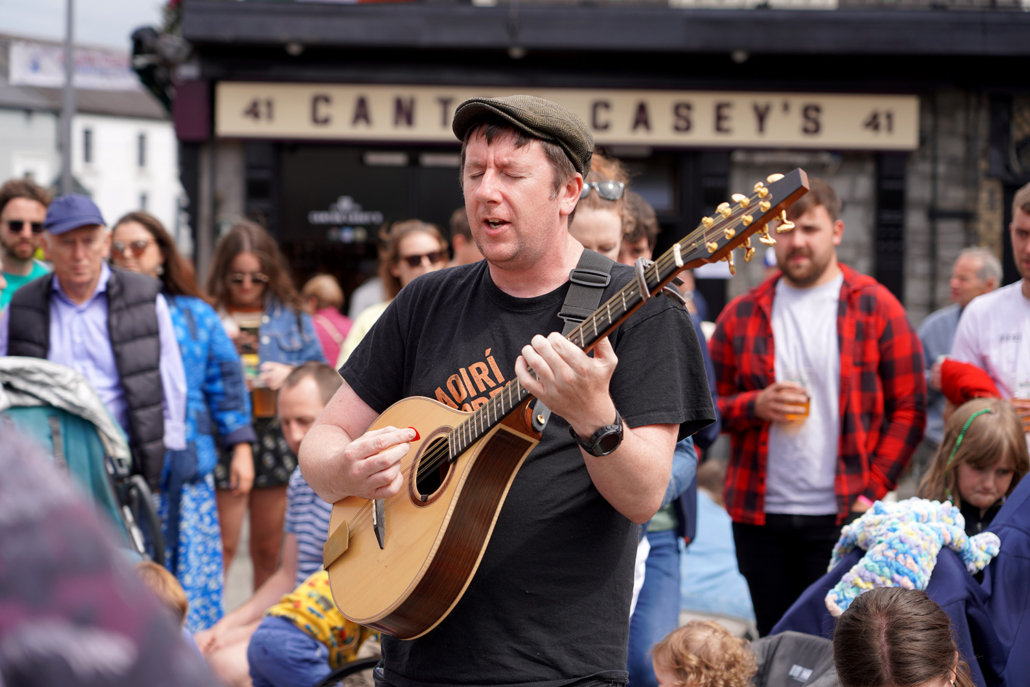
Over the years, I have made and collected several tabs and chord sheets from Daoiri Farrell. Over the last 10 years, he has undoubtedly become one of Ireland's most influential singers.
I first met him in 2011 at a weekend workshop and was impressed by his manner and musicality. At the time, he was still relatively unknown and had just released his first CD, which I had to purchase immediately.
I still have a video of him playing my bouzouki made by Heiner Dreizehnter and singing the song ‘Paddy's Green Shamrock Shore’. I had requested this song because he had sung it at the ceilidh the night before. You can also find this video on YouTube.
Here are the links to my chordsheets and tabs:
The Galway Shawl - Intro and chords
Paddy's Green Shamrock Shore and here
When The Breakers Go Back On Full Time
Here's a link to a concert I filmed with his Trio in 2019. This is an excerpt, The Blue Tar Road.
Daoiri Farrell - The Hills Of Granemore - Lyrics and Chords
“The Hills of Granemore” is a traditional hunting ballad rooted in County Armagh, Ireland. It tells the poignant story of a hare hunt in the hills near Granemore and Keady. Set on a fine morning, the song follows a group of hunters and their hounds as they pursue a hare across the fields. Told with rich natural imagery and dramatic tension, the ballad ultimately shifts perspective to the dying hare, who curses those who brought the hounds and bids farewell to the countryside.
Though often treated as anonymous folk tradition, the song is sometimes attributed to Owen McMahon of Tassagh. It is indexed as Roud 2883 and has appeared in various folk song collections. A local Granemore publication links the song’s origin to a hunt in the winter of 1933–34, said to have inspired a version created in the house of Joe and Pat Toner.
Daoirí Farrell learned his version from the late Al O’Donnell, a singer he greatly admired. Farrell recorded it on his 2019 album A Lifetime of Happiness. His deeply emotive delivery and subtle arrangement highlight the song’s underlying themes of respect for nature, loss, and the fading traditions of rural Ireland.
Unfortunately I couldn't find a live version of Daoiri singing it alone with Bouzouki backing.
{t:The Hills Of Granemore}
{st:Daoiri Farrell}
No Capo
One [G]fine winter’s [D]morning, my [Bm]horn I did [A]blow
To the [D]green fields of [G]Keady, to [A]hunt I did [D]go
We [G]gathered our [D]dogs and we [G]circled [Bm]around
[A]Oh, for none [G]loves the hunt [D]better than the [Bm]boys of May[A]down
And [G]when we ar[D]rived, they were [Bm]all standing [A]there
So we [D]took to the [G]fields in [A]search of the [D]hare
But we [G]did not go [D]far ’til some[G]one gave a [Bm]cheer
[A]Over [G]high hills and [D]valleys, the [Bm]wee hare did [A]steer
When she [G]got to the [D]heather, she [Bm]tried them to [A]shun
But the [D]dogs they never [G]missed her, one [A]inch where she [D]ran
They [G]were kept well [D]packed, going [G]over the [Bm]hill
[A]They [G]had set thems[D]elves on this [Bm]wee hare to [A]kill
And it [G]being quite [D]early, I [Bm]stopped for a [A]while
Twas [D]little I [G]thought they were [A]going to meet [D]Coyle
For [G]had I known [D]that, I’d have [G]lain near the [Bm]town
[A]I’d have [G]tried to get [D]rid of those [Bm]dogs of May[A]down
As we [G]drew o’er the [D]hill it was a [Bm]beautiful s[A]ight
There were [D]dogs black and [G]yellow and [A]dogs black and [D]white
And she [G]took to the [D]black bank to [G]try them once [Bm]more
[A]Oh, and it [G]was our last [D]look on the [Bm]hills of [A]Granemore
And [G]as they grew [D]near where the [Bm]wee hare did [A]lie
She sprung [D]up to her [G]feet for to [A]bid them good[D]bye
But their [G]music did [D]cease and her [G]cry we did [Bm]hear
[A]Saying [G]bad luck the [D]ones brought the [Bm]Maydown dogs [A]here
In a [G]field of wheat [D]stubble, the [Bm]wee hare did [A]lie
And [D]Rory and [G]Charmer, did [A]soon pass her [D]by
And [G]there where we [D]stood at the [G]foot of the [Bm]brae
[A]I [G]heard the last [D]words that the [Bm]wee hare did [A]say
Oh, no [G]more o’er the [D]green fields of [Bm]Keady I’ll [A]run
Or [D]trip through the [G]fields in s[A]port or in [D]fun
For last [G]night as I [D]lay quite con[G]tent in the [Bm]glen
[A]It was [G]little my [D]thoughts were of [Bm]dogs and of [A]men
And [G]no more o’er the [D]green fields of [Bm]Keady I’ll [A]roam
And [D]now that I am [G]dying the [A]sport is all [D]done
Nor [G]hear the long [D]horn that Joe [G]Toner does [Bm]play
[A]Or go [G]home to my [D]bed by the [Bm]clear light of [A]day
Oh, you may [G]blame Ole Mc[D]Maddon for [Bm]bringing Coyle [A]here
He’s been [D]at the same [G]caper for [A]manys' the [D]year
Every [G]Saturday and [D]Sunday, he’ll [G]never give [Bm]o’er
[A]With a [G]pack of strange [D]dogs ’round the [Bm]hills of Grane[A]more
If you copy these lyrics and import them into an lyrics and chords app like Songbook you can see the chords above the lyrics, transpose etc. In the Songbook app you can define Bouzouki as instrument and it has chords implemented so you can see how to play them. You even can define your own chords, which is really handy sometimes. The app is available for most platforms.

Subscribe to:
Posts (Atom)