Darren plays the sea song Go To Sea No More on his Greek Bouzouki. He writes as comment:
Origins of this song have been traced back to the English Merchant Navy. It's thought to have been brought back from San Francisco and changed in England. Reasons being that Liverpool had no whaling industry and there was a known crimper in San Francisoco called Shanghai Brown. Shanghaiing or crimping is the practice of kidnapping people to serve as sailors by coercive techniques such as trickery, intimidation, or violence.
He also made some tutorials for Irish Bouzouki. You'll find them here:
[D] [G] [D] Oh, me [D]name it is Sam [G]Hall, chimney [D]sweep, chimney [A]sweep Oh, me [D]name it is Sam [G]Hall, chimney [D]sweep
Oh, me [G]name it is Sam Hall, and I've [D]robbed both great and [A]small And me [Bm]neck will pay for [G]all, when I [D]die, when I [A]die And me [Bm]neck will pay for [G]all, when I [D]die
I have [D]twenty [F#m]pounds in [Bm]store, [D]that's not [G]all, that's not [A]all I have [D]twenty [F#m]pounds in [Bm]store, that's not [G]all
I have [Em]twenty pounds in [G]store, and I'd [D]rob for [F#m]twenty [A]more For the [D]rich must [F#m]help the [Bm]poor, [D]so must [G]I, so must [A]I For the [D]rich must [F#m]help the [Bm]poor, so must [G]I
Oh, they [D]took me to Coot[G]hill, in a [D]cart, in a [A]cart Oh, they [D]took me to Coot[G]hill, in a [D]cart
Oh, they [G]took me to Coothill, where I [D]stopped to make my [A]will For the [D]best of friends must [G]part, so must [D]I, so must [A]I For the [D]best of friends must [G]part, so must [D]I
Up the [D]ladder I did [G]grope, that's no [D]joke, that's no [A]joke Up the [D]ladder I did [G]grope, that's no [D]joke
Up the [G]ladder I did grope, and the [D]hangman he pulled his [A]rope But [D]ne'ar a word I [G]spoke, tumbling [D]down, tumbling [A]down But [D]ne'ar a word I [G]spoke, tumbling [D]down
Oh, me [D]name it is Sam [G]Hall, chimney [D]sweep, chimney [A]sweep Oh, me [D]name it is Sam [G]Hall, chimney [D]sweep
Oh, me [G]name it is Sam Hall, and I've [D]robbed both great and [A]small And me [D]neck will pay for [G]all, when I [D]die, when I [A]die And me [D]neck will pay for [G]all, when I [D]die
I tried to tab the backing for the first verse to study Eoin's playing. Here is my humble attempt. It is for the tuning of ADAD. But as the A-string is rarely used it is also possible for GDAD with the exception of 2 notes in bars 13 and 16, it has to be 2nd fret on G-string which gives the needed A.
Last October I took part in an online workshop with Eoin O'Neill. 9 video lessons, each around 20-30 minutes long he produced for the O'Flaherty retreat 2020. What an inspiration. Since then I play bouzouki in ADAD most of the times. It's much fun to back tunes in ADAD. But when singing I still use GDAD.
During that workshop he backed the singer Clara Buteler when singing "Down by the sally gardens". Now I tried to tab the accompaniment of the first verse. So here it is. Unfortunately I can't post the video here.
The Tab is for ADAD, but if you use GDAD it is nearly the same. Only one note is played on the low string, so you just have to play this D-Note on the 7th fret instead of the 5th fret which is notated for ADAD.
A new tutorial from Matt Heaton. A very in deep tutorial how to play counter melodies. Basic rule to this: you have to know the tune you're accompanying very well. Otherwise it might clash with the melody.
Daoiri did lots of online concerts during the pandemic in the last months. Here is one he did for the Festival of Oulu which took place Nov. 19th - 21
I think, I don't have to say anything about Daoiri, I first met him in 2011 in Germany and and within these years he has achieved a well deserved success. Alway great to see him.
Well, I'm a bit late with this information, but better late than never ...
Eoin O'Neill offers an online workshop for Bouzouki at the O'Flaherty's Retreat 2020. It runs from Out. 18th until Nov 8th, so it is already online. It cost 150$ and you'll get 9 Lessons each lasts around 25 - 30 minutes You can register here:
The online workshops are available until December, so enough time to learn from/with Eoin. I'm so happy to have the opportunity to learn the way Eoin plays. This might be the only good thing about Corona.
Found this now 10 years old Video on my hard disk. I filmed it at a concert in a small village in Northern Germany. The concert was sold out and I had bought no ticket in advance. Luckily they opened up the room and let me and some more people in. Btw. I drove more than 700 km to see Andy there, well, to be honest, I also wanted to visit my sister who lives there ;-)
Matt's workshop for this weeks is all about accompanying in Em without capo. He gives some ideas to play in Em which might be useful when accompanying a set of tunes in different keys.
This time no chord diagrams necessary, just watch the video.
Matt offers his first bouzouki tutorial. This one is about right hand technique. In this way he shares my opinion about accompanying tunes on the bouzouki. It sounds better if the bouzouki is played different from a guitar.
And don't forget to tune in to the Heaton's slow session on youtube every Saturday, and maybe donate some money to them if you have something spare: PayPal button -- https://tinyurl.com/wqofe4b
At the last Slow Session Matt and Shannon played the warmup jig first in G and then in A. It's a nice idea to change the key during a tune. Works very well for the Haunted House.
So far I avoided playing in A. I always used the capo on 2nd fret and played G-shapes. So I found it very interesting how Matt manages playing in A.
Here's the video: Jig starts at 2:45, Jig in A starts at 4:54.
Btw. if you like what they are doing or if you like my tabs please consider to donate any amount you like to the Heatons virtual tip jar:
PayPal button -- https://tinyurl.com/wqofe4b
This is the tab I made for the first round through the tune: Hope it is nearly correct. If you find any mistakes please let me know.
In the last bars of the tune (2nd round through) Matt uses a nice chord progression:
A new Slow Session from the Heatons last Sunday. The warmup Jig played on bouzouki. First in G, then in A. It's a nice idea to change the key during a tune. Works very well for the Haunted House. Here's the video: Jig starts at 2:45
Btw. if you like what they are doing or if you like my tabs please consider to donate any amount you like to the Heatons virtual tip jar:
PayPal button -- https://tinyurl.com/wqofe4b
This is the tab I made for the first round through the tune: Hope it is nearly correct. If you find any mistakes please let me know. I will post a tab in A later.
Well, as Matt uses some interesting chords and rhythmic variations in the third round through I made a tab for it also. So here it is:
For all lovers of odd rhythms and modern Folk here's a relatively new band from Finland. Alex, a reader of my blog reminded me of them, many thanks for that. I once listened to their album when it came out but forgot about them. So I gave it another try. Fantastic musicians.
Today I tried to find out different variations to accompany the march Lord Mayo. Starting point was the video by Matt & Shannon Heaton. Matt plays Gm-Chords with Capo on 2nd fret. Then I found the version of the Floating Crowbars. They play Dm-Shapes with Capo on 7th fret. So I had 2 different approaches. Then I thought, how it would sound with Am-shapes without capo and tried different chords.
So at first here are some possibilities without capo, maybe you'll find some more:
Not every attempt sounds good to everyone, so you have to decide what suits you.
Here are some chords that might be useful in Am:
Now lets look at Gm-shapes with capo on 2nd fret. First here's the video of Matt & Shannon Heaton. Lord Mayo starts at 42:20.
Now let's look at the recording of the Floating Crowbars. They use Dm-shapes with capo on 7th fret:
I really like the intro and groove of this accompanyment. Here's a tab for it:
Another lovely slow session by Matt and Shannon Heaton. This times two sets with bouzouki. One of them a beautiful An Dro called the Wren. I know it for many years as a song by Tri Yann from France. They called it Kerfank 1870 and it is on their Album "Urba". If you don't know it give it a listen. This is the album where they began to change their style to be more electric.
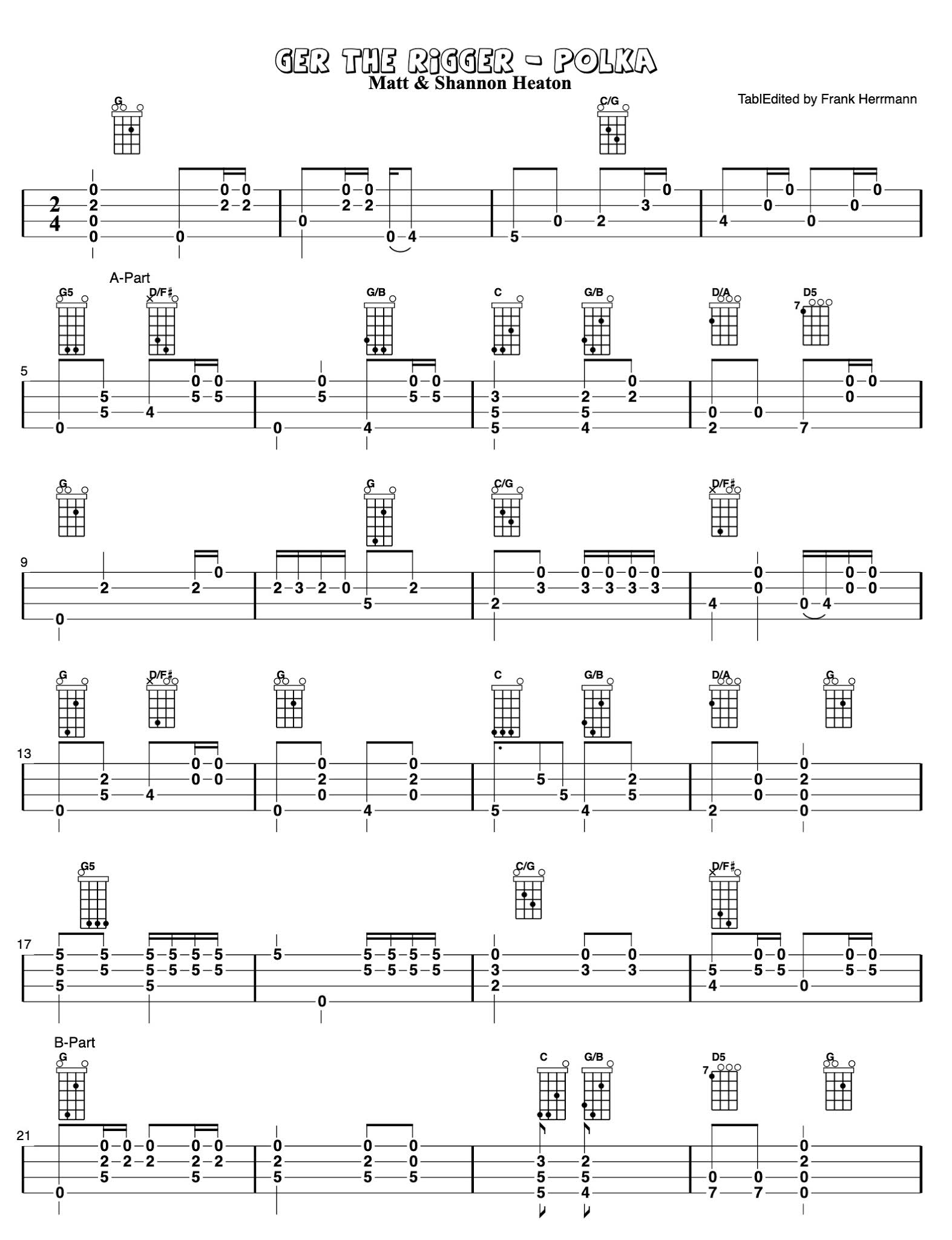
This is a slow Polka in G. Shannon and Matt are playing it nice and slow. The tune starts at 3:05.
This is the tab I made for the first time round the tune. Looks more difficult that it is. First time I tried to write a tab for a Polka. 2/4 time. I hope I did it right.
Btw: If you like my blog please click on "Follow" on the right, so you will get notified whenever there is a new post.
I also made a tab of the 2nd time round the tune because Matt uses several chords up the neck here:
Here is a tab for the melody at capo 2. I made it from the second file on thesession.org with the program tabledit, but changed a few little things. https://thesession.org/tunes/1367
From the Heaton's weekly virtual session from July, 25th here is a jig called The Haunted House. Matt uses several voicings for G, C and D. Tune starts at 7:42.
A slow march played by Matt & Shannon Heaton called Sean South of Garryowen. Matt plays in G without capo. He uses several voicings for G, C and D. Tune starts at 3:18.
I tried to write down the first round through the tune. Hope, I got it right. Here's my tab:
From the classic album Mary Bergin and Alec Finn: Feadoga Stain this is a wonderful reel.
I tried to write down the accompaniment of Alec for the first round
through the tune just to get to know a bit what he is doing. I'm not
always sure what his right hand is doing as he sometimes breaks through
the up and downs. Updated Aug 21st 2020, added chord shapes and corrected mistake in measure 6.
And here is the tab for the melody (GDAD). I made it with the program tabledit on the MAC out of a setting that appears on thesession.org in the comments:
Another video of the Heaton Sessions. This time from August, 8th, 2020. The tune is Ships are Sailing and it starts at 25:38. Chords are mostly Em, D and sometimes G.
Here is my chord sheet. I noted where the bass is accented because this is important for the rhythm. There are also some Hammering-Ons. Blue chord names: this is a Bass-line.
Below the tab is a list of used chords. Tuning GDAD. So 9,9,10,0 means for example: G string 9th fret, D string 9th fret, A string 10th fret, D string rings open.
These are the chords for the first time through. Beware, there might be some mistakes in it. If you find one, let me know, please. I think, to understand the writing you have to watch the video and compare. Otherwise it might be a little confusing.
If you want to know more about Matt's approach to Em-Tunes you can watch his Guitar related video to tunes in Em. I included it below.